


Even if you think weights are just for bodybuilders, research shows that simple weight training can boost bone strength by up to 30% in just six months. Women, in particular, are enjoying these benefits daily. Building strength can make everyday tasks easier and lift your mood and confidence. This guide explains how weight training helps both your body and mind, and it offers a safe, beginner-friendly plan to help you feel more in control of your health.
Comprehensive Benefits of Weight Training for Women
Weight training brings many benefits for your body, mood, and metabolism. It builds muscle strength and improves bone health, which is especially important as you get older. Studies show that six months of regular weight training can increase bone mineral density by 20-30%. One trainer shared, "After six months of weight training, my bones feel stronger and I feel more confident in everyday activities."
Building muscle also boosts your resting metabolic rate. When you have more lean muscle, your body burns more calories even when you're at rest. This extra calorie burn can help with managing weight and reducing midsection fat that often comes with hormonal changes. Many women find that lifting weights not only speeds up their metabolism but also makes daily tasks feel easier.
Beyond the physical benefits, weight training lifts your spirits too. Exercise releases hormones that improve your mood and lower stress levels. As you build strength, you might also notice a boost in your confidence and a greater sense of control over your health. Every session becomes a reminder that you're taking care of yourself.
In short, incorporating weight training into your weekly routine can lead to stronger bones, a faster metabolism, and a happier mood. It's a well-rounded approach to health that supports both your physical and mental well-being. If you're considering a new workout routine, speak with your doctor to see if weight training is right for you.
Beginner Weight Training for Women: Safe Starting Protocols

If you're new to weight training, try this easy 4-week plan that shows you how to get started safely. Work out 3 to 4 times each week for about 30 to 40 minutes per session. Begin with a 5-minute warm-up and end with a 5-minute cooldown. This routine helps you learn the movements and gets your body ready to build strength.
Start with dumbbells that weigh 8 pounds. Do 10 repetitions for each exercise and focus on doing them correctly. When the last 2 or 3 reps feel very hard to finish, it means you're ready to increase the weight by 2 to 5 pounds. This slow increase helps your muscles adjust while keeping injuries to a minimum.
Plan your week with at least two rest days. Rest is just as important as exercising because it gives your muscles time to recover and grow. If you feel very sore or tired, add extra rest as needed. Consistency is important for building muscle and improving endurance.
Here’s a quick checklist to guide your sessions:
- 3 to 4 sessions per week
- Each session lasts 30 to 40 minutes with a warm-up and cooldown
- Start with 10 reps per exercise using 8-pound dumbbells
- Increase weight by 2 to 5 pounds when the final reps become very challenging
- Schedule at least 2 rest days each week
This plan is made to gently introduce you to resistance training. As you move forward, keep track of your progress and listen to your body. Focusing on proper form, steady effort, and enough rest will help you feel strong and ready to take on more advanced workouts.
Essential Weight Training Equipment for Women
When planning your workout at home or in the gym, using the right tools can make you feel strong and help you reach your goals. One top choice is adjustable dumbbells. They let you change weights quickly, so you might start with 8-pound dumbbells and increase the weight as you build strength.
Kettlebells are another smart pick. They usually range from 8 to 20 kg and work well for both swinging moves and steady holds. A barbell with 45-pound plates is perfect for exercises that target many muscles at once. Resistance bands also add a safe way to boost the challenge of an exercise and come in a range of strengths from light for warm-ups to heavy for more resistance.
When shopping for your gear, focus on quality and adjustability. Look for items built with durable materials that can handle regular workouts. Adjustable dumbbells, for example, combine multiple weights into one compact design that works well in small spaces. Also, consider equipment that is easy to store and move if space is limited.
Choosing the right tools for your routine can help you maximize results and maintain proper form during both big and small lifts.
At-Home Weight Training for Women: Effective Routines
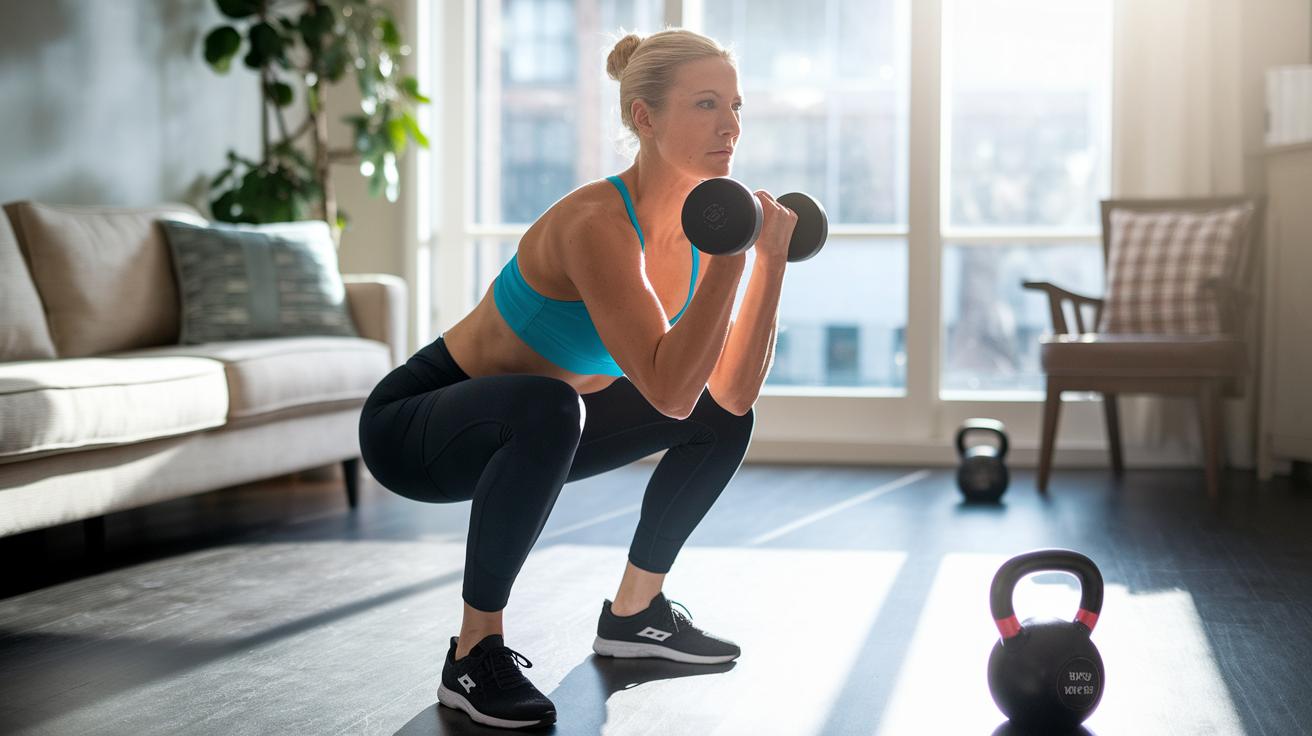
If you’re juggling work, family, and other daily tasks, you can still build strength at home with simple workouts. This routine suggests doing two 30-minute full-body dumbbell circuits along with one kettlebell HIIT session each week.
In one dumbbell circuit, you might perform squats, push-ups, and bent-over rows. Do each exercise for 45 seconds, then rest for 15 seconds before moving to the next move. This setup lets you work several muscle groups quickly.
If you have extra time or want to add variety, you can extend some sessions to an hour by including mobility and core drills. These extra exercises help improve balance and overall fitness, giving you a stronger sense of progress.
Always begin with a 5-minute warm-up using dynamic stretches like leg swings and arm circles to gently raise your heart rate. After finishing your workout, spend another 5 minutes cooling down or using a foam roller to help your muscles recover.
Quick plan:
- Two 30-minute full-body dumbbell circuits
- One kettlebell HIIT session
- 5-minute warm-up (dynamic stretches)
- 5-minute cooldown (foam rolling)
This schedule is ideal for busy professionals and home gym enthusiasts who need an effective workout that fits into a tight schedule.
Core Stability and Proper Form in Women’s Weight Training
Good form is key to a safe and effective weight training routine. Keeping your core stable and using proper technique can help prevent injuries and boost your progress. Lifts such as squats, deadlifts, and bench presses work best when you maintain a straight spine, brace your muscles, and keep your lower back in its natural position. Many trainers even suggest going barefoot or using flat-soled shoes for better balance.
Proper Squat Form
Stand with your feet about shoulder-width apart and point your toes slightly outward. Push your hips back gently while bending your knees, making sure they move in line with your toes. Keep your back flat and your chest lifted as you lower into a squat until your thighs are parallel to the floor. Then press through your heels to stand back up. Many trainers have found that focusing on knee alignment leads to improved performance.
Deadlift Technique
Place your feet hip-width apart and grip the bar just outside your legs. Instead of bending your back, hinge at your hips and keep your shoulder blades pulled in. Maintain a steady, flat back as you lift while keeping the bar close to your body. This hip hinge method helps you lift powerfully and keeps you in control.
Bench Press Position
Lie on the bench and firmly plant your feet on the floor. Squeeze your shoulder blades together as you control the bar along a smooth path. This careful placement of your feet and the pull on your shoulders add extra stability, reducing the risk of injury.
Progressive Training Programs for Women’s Strength Gains

Start with a clear four-week plan that helps you build strength steadily. Follow a routine that challenges your muscles with both supersets and regular sets to keep your progress on track.
Here’s a simple 4-week plan:
- Week 1: Do 3 sets of 10 reps at an effort level of RPE 7 (rate of perceived exertion). This means you work hard while keeping proper form.
- Week 2: Increase to 4 sets of 10 reps at an RPE of 7.5. An extra set helps your body get used to a higher load before you push harder.
- Week 3: Switch to 4 sets of 8 reps at an RPE of 8. With fewer reps, you can lift a bit heavier and feel more effort.
- Week 4: Move to 5 sets of 8 reps at an RPE of 8.5 to add a clear challenge with each lift.
Each week, add about a 5% increase in weight if you feel ready. When the last reps are almost too hard to complete, it’s a good sign to increase the weight a little more. This careful increase not only builds muscle but also helps prevent injuries.
You can set up your workout as supersets or traditional straight sets based on what suits you best. With supersets, pair different exercises to work various muscle groups, keeping your heart rate a bit higher. With traditional sets, take dedicated rest between exercises.
Stick with this plan and check your progress each week. Watching your strength and endurance improve can be really empowering.
Nutrition and Recovery for Optimal Female Weight Training
Getting the most out of your workouts means fueling your body right and giving it time to recover. Try having 30-60 grams of carbohydrates about 30 minutes before you exercise. For instance, a small bowl of oatmeal with berries can boost your energy levels and set you up for a great session.
Protein also plays a big role in helping muscles rebuild and grow. Aim for 1.6-2.2 grams of protein per kilogram of your body weight each day. Enjoy options like chicken breast, tofu, or Greek yogurt after you finish your workout to aid recovery.
Don't forget about rest. Getting 7-9 hours of sleep each night helps your muscles repair and keeps overall fatigue in check. On days when you're not pushing hard in the gym, consider light activities such as stretching or mobility work to encourage recovery without stressing your muscles.
In short, pairing good nutrition with proper rest makes your workouts more effective and helps build strength over time.
Common Mistakes Women Make in Weight Training

Many women lean heavily on cardio workouts and miss out on the benefits of strength training. A balanced mix of exercises helps boost strength, improve muscle tone, and increase metabolism.
Often, people stick with the same routine without adding more weight over time. When you don’t gradually increase the resistance, your muscles aren’t pushed to grow stronger. It’s important to lift a bit more as you get stronger instead of doing what feels easy.
Some women choose very light weights to avoid getting bulky. This can limit progress and keep muscle tone from improving. Skipping warm-ups and cool-downs is another error that can lead to injuries and longer recovery times.
Making a few small changes in your workout routine can help you build strength safely, making each session leave you feeling more confident and empowered.
Real-Life Success Stories of Women Who Lift
A 35-year-old woman changed her health by sticking with regular weight training. Over 6 months, she added 10 lb of muscle and got rid of lower-back pain that had troubled her for years. This shows that building strength not only boosts physical ability but also makes everyday life more comfortable.
Another story comes from a busy professional who made time for three at-home circuits each week. After 12 weeks, she felt a lift in her mood and noticed better posture. Her experience shows that even a packed schedule can include strength training that improves confidence and energy. Each success, whether in pain reduction or increased vitality, highlights the powerful impact that regular weight training can have for women.
Final Words
In the action, the article highlights the benefits of weight training for women that boost strength, bone health, and mood. It details a safe starter plan, proper equipment selection, and techniques that help prevent injury. The guide breaks down effective at-home routines, progressive training steps, and nutrition and recovery tips that support muscle repair. Real-life success stories offer added encouragement. Weight training for women stands as a practical approach to achieving lasting health and strength while fitting into busy schedules.
FAQ
Q: Where can women find weight training options both near me and at home?
A: Women can find weight training classes at local gyms or community centers, while many also build effective routines at home using adjustable dumbbells and resistance bands.
Q: What is a women’s strength training program PDF?
A: A women’s strength training program PDF is a downloadable guide featuring structured workouts, safety tips, and progression plans geared toward building muscle and bone strength.
Q: What should women look for in weight training shoes?
A: Good weight training shoes provide a flat, stable base for improved balance and proper form while lifting, reducing injury risk during workouts.
Q: How should weight training be adapted for women over 50 and over 60?
A: Women over 50 and 60 should focus on controlled movements, proper form, and gradual weight increases to safely build strength, support bone health, and enhance balance.
Q: How can women access free weight training resources?
A: Free weight training resources are available online as workout videos, downloadable guides, and forums that offer step-by-step routines and tips for safe lifting.
Q: What constitutes the best weight training routines for women?
A: The best routines combine compound and isolation exercises, emphasize progressive overload, include ample recovery, and adjust intensity to match individual fitness levels.
Q: How many times a week should a female lift weights?
A: Aiming for 3 to 4 weight training sessions per week allows enough recovery between workouts while promoting steady strength gains.
Q: What does the 3 3 3 rule for weight lifting mean?
A: The 3 3 3 rule typically refers to structuring workouts with three sets of three exercises or reps, which helps beginners manage intensity and maintain balanced training routines.
Q: Are 2kg weights enough to tone arms for a female?
A: Two-kilogram weights may work for beginners or for light toning, but increasing resistance over time is essential to continue challenging muscles and achieving noticeable tone.
Q: How should beginners start weight lifting?
A: Beginners should begin with lighter weights, follow a structured routine with proper technique, and gradually increase the load to build strength safely and effectively.
Q: What benefits do exercises like dumbbell step ups, bench presses, Romanian deadlifts, squats, side lateral raises, and goblet squats provide?
A: These exercises work multiple muscle groups, support core stability, improve balance, and contribute to overall strength, making them key components of a balanced weight training program.